Indian Defence Blog dedicated to Armed Forces - Indian Air Force, Indian Army, Indian Navy and Paramilitary Forces
Monday, January 6, 2014
Saturday, December 28, 2013
India Navy: Tender for domestic construction of four LPDs
The Indian Navy has floated a US $2.6 billion domestic tender for construction of four landing platform docks (LPDs) and bids were sent to domestic shipyards, Larsen & Toubro (L&T), Pipavav Defence and Offshore Engineering, and ABG Shipyard. A senior Navy planner said the service will select a winning design based on the low bidder. State-owned Hindustan Shipyard Ltd. (HSL) then will build two LPDs based on that design and the winning company will build two. This will be India’s first attempt to build the 20,000-ton vessels.
Limiting involvement to only domestic shipyards, despite having no experience in building LPDs, is welcomed by analysts. “This is an extremely wise decision; LPDs are relatively less sophisticated than high-end destroyers and provide a perfect opportunity for domestic private industry to upgrade their skills in warship construction. Private shipyards which have made huge investments in developing modern state-of-the-art shipyards will be able to prove their credentials for undertaking larger and more sophisticated projects,” said Anil Jai Singh, retired Indian Navy commodore and defense analyst.
Italian LPD San Giorgio ( Image Courtesy - keypublishing.com )
The LPD tender states the ship should be no more than 215 meters long and have a draft not to exceed 8 meters, in full load conditions. The ship will be powered by electric propulsion systems and have an endurance of 45 days with a maximum sustained speed of not less than 20 knots. The LPD should be able to carry six main battle tanks, 20 infantry combat vehicles and 40 heavy trucks.
The ship also should be equipped with a point defense missile system, the close-in weapon system, an anti-torpedo decoy system, a chaff system, and heavy and light machine guns. Special operation helicopters and large helicopters, up to 35 tons, will operate from the ship. The LPD should be able to accommodate 1,430 personnel, including 60 officers, 470 sailors and 900 troops.
News Courtesy - defensenews.com
Tuesday, October 8, 2013
Vladivostok - Mistral Class to be launched on October 15
The Russian Navy will receive its first Mistral-class helicopter carrier from France on November 1, 2014, a high-ranking defense industry official told RIA Novosti on Friday.
The Vladivostok, which is being built at the DCNS shipyard in Saint-Nazaire, is scheduled to be floated out on October 15. “Over the course of a year, the ship will be further equipped and undergo sea trials in order to be handed over to the Russian Navy on November 1, 2014,” the official said.
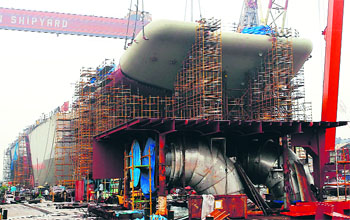
Bow and Stern section of Vladivostok in France ( Image Courtesy - militaryphotos.net )
In October 2014, the second Mistral-class ship will be delivered to Russia, Rogozin added, referring to the helicopter carrier ‘Sevastopol’, which was laid at the DCNS shipyard in France's Saint-Nazaire on June 18.
Russia and France signed a 1.2 billion euro ($1.6 billion) contract for two French-built Mistral-class helicopter carriers in June 2011.
News Courtesy - en.ria.ru
Saturday, September 28, 2013
Indian Navy: Tender for six Project 75-I Submarines
The Indian Navy is just one step away from issuing a global tender worth almost eight billion dollars for six conventional stealth submarines. Russia is among the four countries which are in a vantage position in bagging the upcoming contracts, the other countries being France, Sweden and Germany, though not necessarily in that order.
Indian Navy’s Vice Chief, Vice Admiral R K Dhowan, said at a press conference in New Delhi on Monday, September 16 that the navy’s proposal for having six hi-tech submarines will be soon placed before India’s apex decision-making body on defence and strategic matters the Cabinet Committee on Security (CCS).
A Lada class submarine at sea-trials ( Image Courtesy - defencetalk.com)
Vice Admiral Dhowan informed that the Defence Acquisition Council (DAC), headed by Defence Minister A K Antony, had given its approval for the proposal to be taken up before the CCS and the global tender will be issued after the CCS nod comes. The navy vice chief said the tender would be worth Rs 50,000 crore, which is about $7.92 billion at today’s exchange rates.
The Indian Navy plans a unique 2+2+2 format for adding the proposed six submarines to its fleet. Sources said the prevailing thought in the Indian Navy is to go for outright purchase of two submarines from abroad and order two submarines each for Indian public sector and private sector companies.
Vice Admiral Dhowan put this point in perspective with a pithy remark: “Navy is poised for growth... over the next decade, we plan to induct at least four to five major combatants (warships and frigates) every year. This provides an ideal opportunity for Indian shipyards and industry to enter into collaborative arrangements or joint ventures.”' Dhowan elaborated that 46 warships and submarines are currently under construction in Indian shipyards.
News Courtesy - indrus.in
Saturday, August 10, 2013
INS Arihant - reactor active, running on nuclear power now
In a major step towards completing its nuclear triad, the atomic reactor on-board the indigenous nuclear submarine INS Arihant was activated late Friday night and the submarine is on its own power now. The submarine will soon be launched to sea on the Eastern coast for extensive sea trials
DRDO has also readied a medium-range nuclear missile BO-5 for being deployed on the Arihant and its last developmental trial was held on January 27 off the coast of Vishakhapatnam.
INS Arihant, till now, was being tested in the harbor on shore-based, high-pressure steam. With the reactor going critical now, the submarine will eventually head for open waters for extensive "sea- acceptance trials", which will include firing of its 750-km range K-15 ballistic missiles.
INS Arihant at launch ceremony ( Image Courtesy - pacificsentinel.blogspot.com.au )
The sea trials will take at least another 18 months before INS Arihant can become fully operational. It will be the first ballistic missile submarine to have been built outside the five recognized nuclear powers — the United States, France, Russia, Britain and China.
Sections of a second submarine, to be named Aridaman are already at an advanced stage of outfitting at the Ship Building Centre (SBC). Sources indicate Aridaman could be launched by next year. Sections of a third submarine are also under construction at the Larsen & Toubro's Hazira facility. The three SSBNs have been under construction under a secret navy-DRDO-Bhabha Atomic Research Centre (BARC) project called the 'Advanced Technology Vessel' (ATV) project.
India's strategic plans call for a fleet of five nuclear powered attack submarines (SSN) and five ballistic missile submarines (SSBN).
News Courtesy - hindustantimesc.om and indiatoday.intoday.in
Wednesday, August 7, 2013
Japan unveils its new aircraft carrier - Izumo
Japan on Tuesday unveiled its biggest warship since World War II, a huge flat-top destroyer that has raised eyebrows in China and elsewhere because it bears a strong resemblance to a conventional aircraft carrier.
The 250 metre vessel, named 'Izumo', is officially labelled as a destroyer, although its flat top can functions as a flight deck like that on an aircraft carrier.
Unveiling ceremony of JMSDF Izumo ( Image Courtesy - dailymail.co.uk)
The ship, which has a flight deck that is nearly 820 feet long, is designed to carry up to 14 helicopters. Japanese officials say it will be used in national defense -- particularly in anti-submarine warfare and border-area surveillance missions -- and to bolster the nation's ability to transport personnel and supplies in response to large-scale natural disasters, like the devastating earthquake and tsunami in 2011.
Unveiling ceremony of JMSDF Izumo ( Image Courtesy - foxnews.com )
Though technically a destroyer, some experts believe the new Japanese ship could potentially be used in the future to launch fighter jets or other aircraft that have the ability to take off vertically. That would be a departure for Japan, which has one of the best equipped and best trained naval forces in the Pacific but which has not sought to build aircraft carriers of its own because of constitutional restrictions that limit its military forces to a defensive role.
News Courtesy - foxnews.com
Friday, August 2, 2013
INS Vikrant to be launched on August 12
India will launch its first indigenous aircraft carrier, INS Vikrant, on August 12 from the Kochi shipyard. This will make India only the fifth country after the US, Russia, Britain and France to have the capability to build such vessels.
"About 83 per cent of the fabrication work and 75 per cent of the construction work will be over when the ship goes into water," said Indian Navy's vice chief, Admiral Robin Dhowan.
The rest of the work, including the flight deck, will be completed once the ship is launched, the Navy vice chief said. The aircraft carrier is expected to be inducted into the Indian Navy by 2018.
INS Vikrant under construction ( Image Courtesy - ndtv.com )
Admiral Dhowan also said that the 40,000 tonne indigenous aircraft carrier is one of its most prestigious warship projects and unprecedented in terms of size and complexity. It has been designed by Indian Navy's design organisation.
INS Vikrant will have two take-off runways and a landing strip with three arrester wires capable of operating a STOBAR (Short Take Off But Arrested Recovery). The main stay fighters positioned on board would be Russian made MiG -29k fighter jets. The naval variant of the Light Combat Aircraft (LCA) produced by India is also scheduled to be positioned on the warship. However, it would depend on how quickly and effectively Navy variant of the LCA is produced and cleared for active duty.
News Courtesy - ndtv.com
Subscribe to:
Posts (Atom)