Saturday, August 10, 2013

INS Arihant - reactor active, running on nuclear power now

In a major step towards completing its nuclear triad, the atomic reactor on-board the indigenous nuclear submarine INS Arihant was activated late Friday night and the submarine is on its own power now. The submarine will soon be launched to sea on the Eastern coast for extensive sea trials

DRDO has also readied a medium-range nuclear missile BO-5 for being deployed on the Arihant and its last developmental trial was held on January 27 off the coast of Vishakhapatnam.

INS Arihant, till now, was being tested in the harbor on shore-based, high-pressure steam. With the reactor going critical now, the submarine will eventually head for open waters for extensive "sea- acceptance trials", which will include firing of its 750-km range K-15 ballistic missiles. 


INS Arihant at launch ceremony ( Image Courtesy - pacificsentinel.blogspot.com.au ) 

The sea trials will take at least another 18 months before INS Arihant can become fully operational. It will be the first ballistic missile submarine to have been built outside the five recognized nuclear powers — the United States, France, Russia, Britain and China.

Sections of a second submarine, to be named Aridaman are already at an advanced stage of outfitting at the Ship Building Centre (SBC). Sources indicate Aridaman could be launched by next year. Sections of a third submarine are also under construction at the Larsen & Toubro's Hazira facility. The three SSBNs have been under construction under a secret navy-DRDO-Bhabha Atomic Research Centre (BARC) project called the 'Advanced Technology Vessel' (ATV) project. 

India's strategic plans call for a fleet of five nuclear powered attack submarines (SSN) and five ballistic missile submarines (SSBN).

News Courtesy - hindustantimesc.om and indiatoday.intoday.in

Wednesday, August 7, 2013

Japan unveils its new aircraft carrier - Izumo

Japan on Tuesday unveiled its biggest warship since World War II, a huge flat-top destroyer that has raised eyebrows in China and elsewhere because it bears a strong resemblance to a conventional aircraft carrier.

The 250 metre vessel, named 'Izumo', is officially labelled as a destroyer, although its flat top can functions as a flight deck like that on an aircraft carrier.


Unveiling ceremony of JMSDF Izumo ( Image Courtesy - dailymail.co.uk) 

The ship, which has a flight deck that is nearly 820 feet long, is designed to carry up to 14 helicopters. Japanese officials say it will be used in national defense -- particularly in anti-submarine warfare and border-area surveillance missions -- and to bolster the nation's ability to transport personnel and supplies in response to large-scale natural disasters, like the devastating earthquake and tsunami in 2011.


Unveiling ceremony of JMSDF Izumo ( Image Courtesy - foxnews.com ) 

Though technically a destroyer, some experts believe the new Japanese ship could potentially be used in the future to launch fighter jets or other aircraft that have the ability to take off vertically. That would be a departure for Japan, which has one of the best equipped and best trained naval forces in the Pacific but which has not sought to build aircraft carriers of its own because of constitutional restrictions that limit its military forces to a defensive role.

News Courtesy - foxnews.com

Friday, August 2, 2013

INS Vikrant to be launched on August 12

India will launch its first indigenous aircraft carrier, INS Vikrant, on August 12 from the Kochi shipyard. This will make India only the fifth country after the US, Russia, Britain and France to have the capability to build such vessels.

"About 83 per cent of the fabrication work and 75 per cent of the construction work will be over when the ship goes into water," said Indian Navy's vice chief, Admiral Robin Dhowan.

The rest of the work, including the flight deck, will be completed once the ship is launched, the Navy vice chief said. The aircraft carrier is expected to be inducted into the Indian Navy by 2018.


INS Vikrant under construction ( Image Courtesy - ndtv.com )

Admiral Dhowan also said that the 40,000 tonne indigenous aircraft carrier is one of its most prestigious warship projects and unprecedented in terms of size and complexity. It has been designed by Indian Navy's design organisation.

INS Vikrant will have two take-off runways and a landing strip with three arrester wires capable of operating a STOBAR (Short Take Off But Arrested Recovery). The main stay fighters positioned on board would be Russian made MiG -29k fighter jets. The naval variant of the Light Combat Aircraft (LCA) produced by India is also scheduled to be positioned on the warship. However, it would depend on how quickly and effectively Navy variant of the LCA is produced and cleared for active duty.

News Courtesy - ndtv.com

Wednesday, July 10, 2013

Indian Navy to lease second Akula class submarine - Iribis

India and Russia are to shortly begin negotiations on the lease of a second nuclear attack submarine for the Indian Navy. The second boat likely to be the completed might be Iribis, an Akula that was only half constructed but abandoned as a result of paucity of funds. 

The recently leased Akula class submarine - INS Chakra II, currently in service with the Navy’s eastern fleet has been on nearly non-stop patrol since its induction in April last year, and the Navy is reported to be very satisfied with its capabilities and performance.

Tentatively christened INS Chakra III, the new submarine will be another advanced variant of the Akula class submarines that are capable of spending months under water. It is likely to be equipped with more lethal weaponry, including a vertically launched Brahmos missile system.


Akula class submarines ( Image Courtesy - naval-technology.com ) 

The submarine is to be reconstructed around the hull of the Iribis, a Russian Akula class submarine that was never completed as funds became scarce in the late nineties. Vladimir Dorofeev, head of the Malachite Design Bureau, said that the new submarine could also benefit from the design efforts that Russia had put in its latest class of Yasen nuclear-powered attack submarines.
News Courtesy - idrw.org and indianexpress.com

Tuesday, July 9, 2013

INS Vikrant to be launched soon - first phase complete

After much delay, the Indigenous Aircraft Carrier (IAC), being built in Cochin, is ready for its launch on August 12. At the same time, the second carrier, INS Vikramaditya, will be undergoing extensive final sea trials in Russia.

While Vikramaditya should join the navy in early 2014, the INS Vikrant would take another three years. The 40,000-tonne aircraft carrier will cross a major development milestone when the ship would be launched by defence minister A.K. Antony, marking the end of the first phase of construction. 


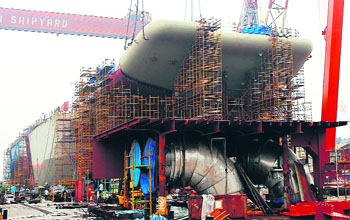
INS Vikrant at Cochin Shipyard ( Image Courtesy - thehindu.com ) 

The launch would mean that the ship would be out of dry dock after completion of work related to fitting all underwater equipment like engines, gear box, shafting and diesel alternators. The construction of the complex warship was undertaken in two phases. Sources in the shipyard said some of the work from phase-II has already started and it is estimated that in two years the ship would be 90 per cent complete.

Despite the delays, the construction of an indigenous carrier is a major boost to country's ship-building capabilities. At the moment, 46 of 47 new naval warships are being built in domestic shipyards. Stealth frigate INS Trikand, which was commissioned in Russia, was the last ship ordered from abroad. Now only the delivery of INS Vikramaditya is awaited.

News Courtesy - indiatoday.intoday.in

Friday, June 14, 2013

Return of Admiral Nakhimov - Kirov Class Battle Cruiser

Sevmash shipyard confirms the return of Admiral Nakhimov - Kirov Class Nuclear Powered Battle Cruiser -

The Admiral Nakhimov, a nuclear-powered missile cruiser currently being overhauled and modernized, will rejoin the Russian Navy in 2018 with the most advanced weapons systems for its vessel type, the Sevmash shipyard said Thursday, June 23, according to RIA Novosti.


Kirov Class Nuclear Powered Battle Cruiser ( Image Courtesy - panarmenian.net 

The Kirov-class cruiser, known as the Kalinin until 1992, was commissioned in 1989 and mothballed in 1999. It has since been docked for upgrades at the Sevmash shipyard in the northern Russian city of Severodvinsk, on the White Sea.

Sevmash deputy head Sergei Marichev said in a statement that the Admiral Nakhimov would become the most advanced heavy nuclear-powered missile cruiser in the Russian Navy.

News Courtesy - panarmenian.net

Sunday, June 2, 2013

INS Vishal might use EMALS for CATOBAR operations

The Indian Navy — one of just nine navies that operate aircraft carriers — is thinking high-tech in planning its second indigenous aircraft carrier, INS Vishal. The admirals are deciding whether INS Vishal, still only a concept, should launch aircraft from its deck using a technology so advanced that it is not yet in service anywhere: the Electro-Magnetic Aircraft Launch System (EMALS).

Getting a fully loaded combat aircraft airborne off a short, 200-metre-long deck is a key challenge in aircraft carrier operations. The INS Viraat, currently India’s only aircraft carrier, uses Short Take Off and Vertical Landing (STOVL) since its Harrier “jump-jets” take off and land almost like helicopters. INS Vikramaditya, which Russia will deliver this year, uses Short Take Off But Arrested Recovery (STOBAR). The Vikramaditya’s MiG-29K fighters will fly off an inclined ramp called a “ski-jump”; and land with the help of arrester wires laid across the deck, which snag on a hook on the fighter’s tail, literally dragging it to a halt. This system will also be used on the first indigenous aircraft carrier, INS Vikrant, which Cochin Shipyard plans to deliver by 2017.


INS Vikramaditya at sea trials ( Image Courtesy - historium.com ) 

But INS Vishal, which will follow the Vikrant, might employ a third technique that India has never used -— Catapult Assisted Take Off But Arrested Recovery, or CATOBAR. Perfected by the US Navy since World War II, this has a steam-driven piston system along the flight deck “catapulting” the aircraft to 200 kilometres per hour, fast enough to get airborne. With greater steam pressure, significantly heavier aircraft can be launched. US Navy carriers launch the E-2D Hawkeye, a lumbering Airborne Early Warning (AEW) aircraft that scans airspace over hundreds of kilometres.

EMALS, the new-generation catapult that the Indian Navy is evaluating, uses a powerful electro-magnetic field instead of steam. Developed by General Atomics, America’s largest privately held defence contractor, EMALS has been chosen by the US Department of Defence for its new-generation aircraft carriers. The first EMALS-equipped carrier, the USS Gerald R Ford, will enter service by 2016. In Delhi Last Thursday, General Atomics briefed thirty Indian Navy captains and admirals on EMALS. Scott Forney III, the senior General Atomics official who conducted the briefing, told Business Standard that tight US controls over this guarded technology required special permission from Washington for sharing technical details of EMALS with India.

Senior Indian naval planners tell Business Standard that INS Vikrant, India’s next 40,000 tonne aircraft carrier, will use STOBAR to operate its complement of MiG-29K and Tejas light fighters. But Vikrant’s successor, the 65,000 tonne INS Vishal, could well be a CATOBAR carrier that launches larger and more diverse aircraft.

“While current fighters like the MiG-29K can operate with STOBAR systems, our options will increase with CATOBAR. We could operate heavier fighters, AEW aircraft and, crucially, UCAVs (unmanned combat air vehicles). A UCAV would require a CATOBAR system for launch,” says one admiral.

News Courtesy - business-standard.com